Past the Headlines, Toward the Horizon
Past the Headlines, Toward the Horizon
Invest for what S&P 500 earnings growth looks like down the road.
Wall Street expects CY2027 earnings of $390.
That gets me to a year-end target of 8,100.
The hardest part of investing isn’t confronting the moment you’re in; it’s having conviction in the one that comes next…
Great investors aren’t anchored to the present. They’re mapping the world several years down the road, knowing that today’s uncertainty eventually gives way to tomorrow’s clarity. By staying disciplined and positioning for that future, they end up selling to the same people who will be chasing those opportunities a year from now.
Applying that forward vision is important right now. The initial shock of the conflict in Iran injected heavy anxiety into global markets. But the ceasefire has shifted the narrative from acute crisis to a fragile stabilization phase. History gives us a reliable compass here: geopolitical flare‑ups tend to be sharp but short‑lived, with the global economy regaining its footing far sooner than the headlines suggest. The real edge lies in looking past the truce and sketching the post‑conflict landscape. Because when the noise clears, markets reward the investors who kept their eyes on the horizon…
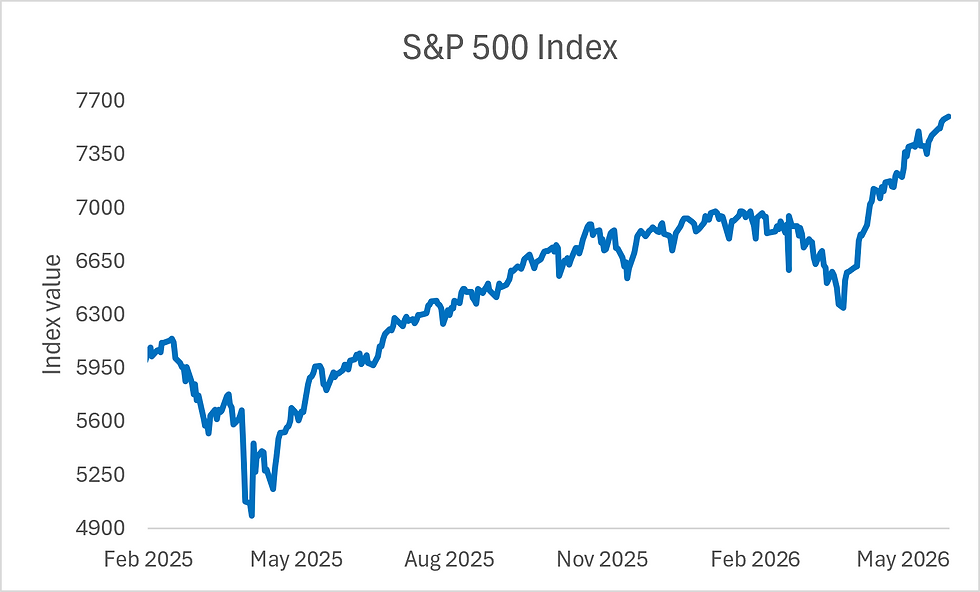
With first‑quarter earnings behind us, analysts have raised their expectations for profits and outlooks. According to FactSet, S&P 500 calendar‑year 2026 earnings estimates have climbed from $310 to $338 over the last six months. Wall Street now expects earnings to approach $390 in 2027. Based on my math, those estimates imply the S&P 500 could rally another 10% by year‑end.
But don’t take my word for it, let’s look at what the data’s telling us…
Coming into the first quarter, analysts were typically conservative. At the start of April, Wall Street expected S&P 500 companies to deliver 13.1% earnings growth. That forecast missed the mark. With results now complete, growth came in at 28.6%...

The rapid integration of artificial intelligence has become a major driver of financial momentum across Wall Street.
JPMorgan Chase CEO Jamie Dimon has framed this as an enterprise-wide shift that is already delivering measurable cost savings.
Dimon has even noted that these immense productivity gains could eventually pave the way for a compressed 3.5-day workweek for the next generation of banking professionals.
Leadership at Goldman Sachs and Bank of America view AI as a vital catalyst for organizational restructuring, deploying autonomous workflows to sharply optimize operating efficiencies.
To fuel this transition, these institutions are backing their ambitions with massive capital deployments:
JPMorgan Chase has an annual technology budget hovering near $18 billion, a massive portion of which is dedicated to multi-step agentic workflows.
Goldman Sachs has concentrated its financial spend on high-stakes back-office automation, co-developing advanced Claude AI agents.
Bank of America has made aggressive capital commitments to buying and building intelligence networks that executes tasks end-to-end.
That spend is helping power demand and margins for the goods and services offered by major technology companies.
Microsoft said commercial AI demand continues to "run ahead of available capacity" despite their massive infrastructure investments.
Amazon stated newly added server capacity is "already spoken for" through long-term corporate contracts for computing power that hasn't even been fully deployed yet.
Nvidia reported a 92% year-over-year surge in AI data center revenue to $75.2 billion, with CEO Jensen Huang summarizing that enterprise and hyperscaler "demand has gone parabolic."
As I said at the top, analysts ended last year expecting 2026 earnings of $310 and 2027 earnings of $342. Today, those numbers stand at $338 and $390…

The next step is to apply a suitable price‑to‑earnings multiple to estimate fair value. Let’s use the current price-to-earnings multiple of roughly 21x earnings.
Remember, we want to invest today based on what earnings potential will look like 12 months from now. By the end of August, when second‑quarter results are complete, the market should be priced off the forward 12‑month estimate. Multiplying 21x by $365 yields a price target of 7,665 for the S&P 500, or just above current levels.
But let’s take it further. It’s early June, and most of the year is still ahead. By the end of 2026, the S&P should be trading on the 2027 earnings estimate. Using the same fair‑value math, I get to 8,180, or roughly 10% above current levels.
Look, the market isn’t irrational, it’s early. The road ahead is always going to be filled with uncertainty. But while the pundits wait for clarity, disciplined investors are already positioning for what’s next. With earnings power accelerating and AI driving margin expansion, the S&P 500 isn’t topping out—it’s gearing up. Invest in the road ahead.
Five Stories Moving the Market:
Google parent Alphabet is raising $80 billion in equity offerings to help fund its artificial intelligence spending plans; the offering includes a $10 billion investment deal with Berkshire Hathaway, as well as another $70 billion in equity and convertible preferred stock – Bloomberg. (Why you should care – the company is avoiding a longer-term debt raise)
Hewlett Packard Enterprise posted record second-quarter results, prompting it to accelerate its long-term financial goals by two years, as expansion of AI data centers boosts demand – Reuters. (Why you should care - HPE raised its fiscal 2026 revenue growth outlook to between 29% and 33%, up from its prior expectations of 17% to 22%)
Anthropic, the $965 billion-valuation artificial intelligence lab, has filed confidentially for an initial public offering, according to the company; the filing could put the company behind the Claude AI model on a path to go public this fall – WSJ. (Why you should care – the upcoming calendar for initial public offerings is likely to lead to a reallocation of resources from other high-flying technology investments)
Duke Energy, one of the largest U.S. electric utilities, said it has talked to hyperscalers about the prospect of building new nuclear power if the technology companies take on some of the financial risk of building the reactors; Duke, which is based in North Carolina and serves a large swath of the broader southeast U.S., has seen massive demand from companies building energy-intensive data centers – Reuters. (Why you should care – partnership with hyperscalers would help to defray costs while potentially driving technological innovation)
U.S. manufacturing activity expanded in May at the fastest pace in four years, bolstered by a pickup in new orders and production; the Institute for Supply Management’s manufacturing gauge has now signaled expansion for five straight months, pointing to renewed vigor in the manufacturing sector amid a surge in artificial intelligence investment – Bloomberg. (Why you should care – the rebound points to steady second-quarter domestic economic growth; the latest Atlanta Fed GDPNow estimate is for 3%)
Economic Calendar:
Earnings: DG, PANW, ULTA
Fed’s Kashkari (Minneapolis, Voter) Speaks (1:50 a.m.)
U.K. – BoE Consumer Credit for April (4:30 a.m.)
Eurozone – CPI (Final) for May (5:00 a.m.)
BoE’s Bailey (Governor) Speaks (10:00 a.m.)
U.S. – JOLTS Job Openings for April (10:00 a.m.)
U.S. – IBD/TIPP Economic Optimism for June (10:10 a.m.)
Treasury Auctions $75 Billion in 6-Week Bills (11:30 a.m.)
U.S. - American Petroleum Institute Crude Oil Inventory Data (4:30 p.m.)
Japan – Au Jibun Bank Japan Services, Composite PMI (Final) for May (8:30 p.m.)
Australia – GDP for Q1 (9:30 p.m.)
China – Caixin China Services PMI for May (9:45 p.m.)


Comments