A Slow Burn: Inflation Keeps Easing
- Christopher Garliss
- 22 hours ago
- 5 min read
The average price for a gallon of gasoline fell about 3% in July.
Regional Fed prices received data showed a decline last month.
The scenario could drive real rates higher.
The inflation picture continues to improve…
This week delivers a key update for investors tracking the Federal Reserve’s monetary policy outlook. The U.S. Bureau of Labor Statistics (“BLS”) will release its July Consumer Price Index (“CPI”). And based on my recent gas station visits, prices have continued to fall.
According to the Energy Information Administration (“EIA”), the average gallon of gasoline last month cost $4.06. According to my calculations, gas prices dropped 3% on a month-over-month basis in June. That marked two straight monthly declines for the first time since December-January…

As the chart above shows, the first half typically produces the bulk of the price growth for the year.
This past month exceeded the typical 1% decline for July.
The Cleveland Fed’s staff projects headline CPI could fall to 3.4% compared to 3.5% in June.
That should soothe Wall Street’s anxieties about a September rate hike.
Chairman Kevin Warsh has signaled our central bank is willing to be patient. Recent commentary from other policymakers indicates their anxieties are up, but they’re hoping a resolution to the Iran conflict will keep weighing on oil prices and inflation growth. Based on the data I track, price growth is on the decline once more. That gives the Fed room to stay on hold.
But don’t take my word for it, let’s look at what the data’s telling us…
To get an idea of what inflation growth might look like each month, I built a gauge using monthly manufacturing and services index data from the Dallas, Kansas City, New York, and Philadelphia Fed districts. These surveys ask businesses whether activity is rising, falling, or holding steady, and then publish indexes to capture the change. Together, these regions represent roughly 32% of national economic output. I focus on the “prices received” components because they serve as a proxy for CPI.
Each district is weighted by its contribution to national growth, giving us a cleaner read on how they influence the overall picture.
In July, the combined manufacturing prices‑received index came in at 26.
That’s down from 29.7 in June.
That makes back-to-back monthly declines for the first time since late-2025, when price growth hovered around 2.7%.

Manufacturing accounts for about 10% of domestic output. Services matter more. That sector includes healthcare, education, finance, hospitality — the parts of the economy where most Americans work and spend.
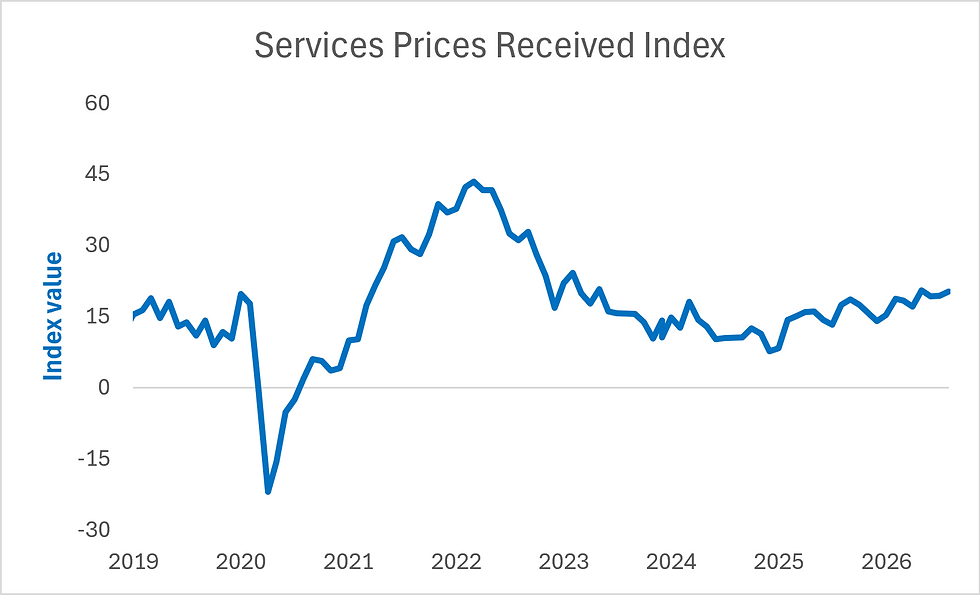
My gauge shows the services index rose to 20.3 in July.
That compares to the recent 20.5 peak in April.
That’s still within the range of recent outcomes.
Next, I blended the two measures, weighting them by economic importance and their relevance to CPI. Because services dominate the U.S. economy, they carry more sway in the combined reading.
The composite came in at 22.3 for July.
That compares to 23 in June and the recent peak of 24.2 in April.
This is above the recent range, but it keeps cooling.

This matters because it tells the Fed that companies are raising prices on consumers, but the pace is slowing. They’re likely passing on the elevated fuel costs from the last few months. In fact, the details show Dallas was the bulk of the increase, while gauges eased in Philly and New York, while holding steady in Kansas City. This gives policymakers the ability to remain on hold with interest rates. But their tolerance has approached the end of its rope. If prices keep surging, a rate hike is all but certain.
So, the last step is to measure the Fed’s interest rate cushion. We can do this by looking at the real rate of interest (effective federal funds rate minus inflation). A positive number means policy is weighing on price growth, while a negative number means rates are stoking inflation. According to the most recent CPI figures, rate hikes aren’t yet necessary…

In June, the effective federal funds rate was roughly 3.6% while inflation stood at 3.5%. That means policy is about 10 basis points above the so‑called neutral level, where rates neither help nor hinder growth. And since the Fed has managed the real rate to an average of –0.6% since 2000, it implies policymakers have 70 basis points of room to maneuver.
Now let’s apply the Cleveland Fed’s 3.4% CPI estimate for July. Under that scenario, the current rate‑cut cushion rises to just 0.2%. When we factor in the long‑term average, it tells us the Fed regains more wiggle room.
Bottom line: the margin for rate cuts is thin. The Fed still has room to stay on hold, but policymakers’ anxieties are up. However, if the situation in the Middle East is resolved, the door to lower borrowing costs could open back up next year. That should help to underpin a steady, long‑term rally in the S&P 500.
Five Stories Moving the Market:
Iran said that a deal with Oman defining new shipping lanes in the Strait of Hormuz was in its final stages but reiterated that the waterway would only reopen once the United States met other conditions; Tehran listed demands including ending U.S. threats against Iran, stopping aggression against Iran and its Lebanese, Palestinian, Yemeni and Iraqi allies, lifting a blockade and sanctions on Iran, and freeing Iranian assets – Reuters. (Why you should care – many of the terms laid out by Iran are non-starters for the U.S.)
Key members of President Donald Trump’s foreign policy team — special envoy Steve Witkoff and son-in-law Jared Kushner — may visit Kyiv and Moscow within the next seven to 10 days, according to Russian state-run Tass news agency; the possible trip would mark a renewed push by Trump’s two main intermediaries in the Russia-Ukraine talks after earlier negotiations to end the conflict stalled – Bloomberg. (Why you should care – a peace deal would help to free up more energy and metal commodities, among others, for sale on global markets, weighing inflation growth
China's producer price inflation eased more than expected in July to its weakest in three months, while consumer inflation also cooled; CPI edged down 0.1%, compared with an expected 0.2% gain and following a 0.3% dip in June – Reuters. (Why you should care – China’s Politburo has signaled it will boost fiscal stimulus measures to reignite economic growth)
Strong earnings reports from the U.S.’s largest companies are powering major indexes to new highs, easing some concerns that the recent rally is overly dependent on a handful of artificial-intelligence stocks – WSJ. (Why you should care – S&P 500 Index member companies’ earnings are on track for record growth based on data going back to 2008)
A surprise drop in U.S. payrolls renewed worries about the job market in the world’s largest economy, suggesting employers are growing cautious – Bloomberg. (Why you should care – a slow growing domestic labor force is likely to ease pressure on the Federal Reserve to raise interest rates)
Economic Calendar:
Earnings – ALC, FERG, RKLB, SLAB, SPG
Fed’s Bowman (Board Member, Voter) Speaks (Saturday)
China – CPI and PPI for July
Japan – BoJ Summary of Opinions
Eurozone – Sentix Investor Confidence for August (4:30 a.m.)
U.S. – Conference Board Employment Trends Index for July (10 a.m.)
Treasury Auctions $92 Billion in 13-Week Bills (11:30 a.m.)
Treasury Auctions $79 Billion in 26-Week Bills (11:30 a.m.)


Comments