Two Jobs Reports, One Clear Signal: Slowdown
- Christopher Garliss
- 3 minutes ago
- 5 min read
ADP data showed businesses added just 38,000 jobs in August, the softest reading since January.
JOLTS figures showed job openings still edged out the unemployed, but the cushion keeps shrinking.
These numbers raise the stakes for Friday's payroll report and the Fed's September 16 decision.
The labor market is still cooling. It's just doing it in an even lower gear now...
Earlier this year, I laid out how I see the labor market taking shape. I walked through the forward-looking indicators I track to handicap each month's payroll report. One of those is the combined hiring gauge from the regional Federal Reserve manufacturing and services surveys shown below. It surged off the 2020 floor and peaked near 19 in 2021. It's been grinding lower ever since, dipping negative more than once along the way. It caught a brief second wind over the summer before rolling back down again. That pattern has tracked the labor market's broader loss of momentum almost step for step.
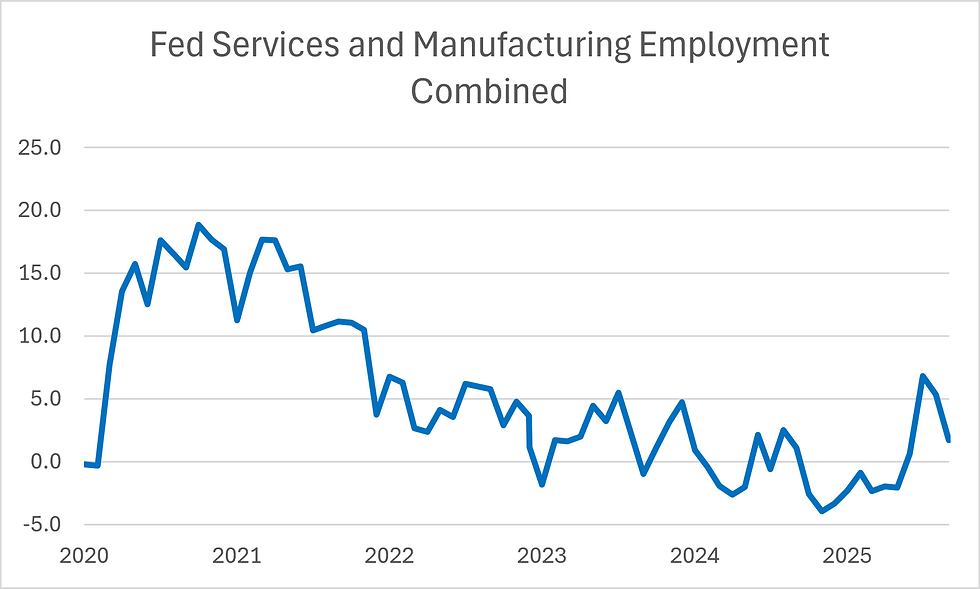
That's exactly what's played out. The BLS's June payroll gain, first reported at 57,000, was revised down to just 20,000. Then July delivered the real shock: payrolls fell by 23,000, the first outright monthly decline in more than two years. The unemployment rate actually ticked down to 4.1% from 4.2%. But that's not the good news it looks like. Labor force participation kept falling too. Some of that "improvement" just reflects people dropping out of the workforce, not finding jobs.
That's why I'll be watching Friday's jobs report more closely than usual. Wall Street is looking for a 58,000-job gain and an unchanged 4.1% unemployment rate. That's modest by any historical standard. And it comes after two of the last three months missed to the downside. A print anywhere near that estimate would mark the fourth straight sub-100,000 reading. Signs that hiring has shifted into a much lower gear might give the Fed reason to stay on hold at its September 16 policy meeting. That would underpin a steady rally in the S&P 500 Index.
But don't take my word for it, let's look at what the data's telling us...
The BLS Job Openings and Labor Turnover Survey ("JOLTS") data for July showed the number of available positions ticked up to 7.3 million, from 7.2 million in June. That's still a drop of roughly 5 million from the March 2022 peak of 12.3 million...

The more telling metric, though, is how openings stack up against the number of unemployed workers:
By looking at the ratio, we get a sense of whether the job market is tightening or loosening.
Tightening means employees are harder to find, driving up wages.
Loosening means more people are seeking work, keeping a lid on pay.
In July, about 6.9 million people were unemployed against 7.3 million openings, or roughly 1 job opening per job seeker. That ratio ticked up slightly from June's 1.01, but it's still well below the five-year average of 1.3. It's hovered near this level for close to two years and now sits near pre-COVID norms...

Employee turnover is also slowing. The quits rate held at 1.9% in July, matching its lowest level outside the pandemic period. Workers aren't quitting because they're not confident, they can walk into something better...

ADP's August hiring data told a similar story. The firm estimates companies added just 38,000 workers last month.
That was down from the gain of 44,000 in July.
It's well below the typical August gain of 207,000 since 2011.
It marks the 15th consecutive month of below-average hiring.

These signals matter because they shape how the Federal Reserve responds. The recent oil price gains tied to the Iran conflict have traders debating whether the Fed's next move might be a hike, not a cut. But the labor market isn't weak enough to force a cut. That combination points to the Fed staying on hold at its September 16 meeting. That makes Friday's report, right before that decision, one of the most consequential data points of the year.
Bottom line: if Friday's report lands anywhere near expectations, look for the Fed to stay on hold at its September 16 meeting. Because the data would be soft enough to keep a hike off the table but not soft enough to force a cut with oil-driven inflation risk still in the picture. A hold removes uncertainty in either direction, and combined with resilient corporate earnings, should keep underpinning a steady rally in the S&P 500 Index.
Five Stories Moving the Market:
Broadcom Chief Executive Officer Hock Tan predicted a surge in artificial intelligence chip sales over the next two years; he said AI chip revenue will double to about $115 billion in fiscal 2027 and soar to $230 billion the following year – Bloomberg. (Why you should care – management said demand continues to rise for its custom AI chips as well as networking products)
Microsoft said that Azure had $29.4 billion in sales in its most recently ended quarter and $101.9 billion in sales in its most recent fiscal year ended June 30; the figures place Microsoft behind Amazon, whose cloud sales were $42.2 billion in its most recent quarter, but ahead of Google, which reported $24.8 billion in cloud sales in its most recent quarter – Reuters. (Why you should care – Microsoft had not previously broken out these numbers, which signals increasing confidence in the demand for its cloud-based products)
Snowflake raised its outlook for annual sales, topping analysts’ estimates, and touted rapid adoption of its AI-assisted coding tool; product revenue in the year ending in January will be about $6.07 billion, an increase from its May forecast – Bloomberg. (Why you should care – the numbers and guidance should act as another tailwind for enterprise software companies)
Economic activity grew modestly since early July, with consumer spending, manufacturing, tourism, and non-residential construction (notably data center-related) all ticking up, while auto sales and residential construction lagged; the outlook stayed positive but mixed, clouded by uncertainty over higher energy prices, policy, and international conflict – Federal Reserve. (Why you should care: the AI infrastructure trade isn't just a stock-market story anymore. Data center-related manufacturing and construction are doing the heavy lifting for this economy)
Russia’s increasingly brazen string of small-scale attacks in Europe creates a dilemma for the continent’s leaders: Are they ready to respond to Moscow with more than sanctions and diplomatic wrist-slaps? The answer is not yet - WSJ. (Why you should care - Russia’s increasing tests of Europe’s willingness to respond is forcing European countries to spend more on defense will further isolating Moscow)
Economic Calendar:
Earnings: CIEN, CPB, CPRT, DOCU, GWRE, LULU
Switzerland - GDP for Q2 (3 a.m.)
Eurozone - HCOB Services, Composite PMI Final for August (4 a.m.)
U.K. - S&P Global Services, Composite PMI Final for August (4:30 a.m.)
U.S. - Challenger Job Cuts for August (5:30 a.m.)
Fed's Waller (Board, Voter) Speaks (8:30 a.m.)
U.S. - Initial Jobless Claims (8:30 a.m.)
U.S. - Continuing Claims (8:30 a.m.)
U.S. - Exports, Imports for July (8:30 a.m.)
U.S. - Unit Labor Costs for Q2 (8:30 a.m.)
Canada - Exports, Imports for July (8:30 a.m.)
U.S. - S&P Global Services, Composite (PMI) Final for August (9:45 a.m.)
U.S. - ISM Non-Manufacturing PMI for August (10 a.m.)
Fed's Balance Sheet Update (4:30 p.m.)
Japan - Household Spending for July (7:30 p.m.)


Comments